You finally booked the venue. The date is set, the pastor is confirmed, and now you are staring at a blank invitation template trying to figure out what to actually say. Wedding invitation wording sounds like a small detail until you are the one writing it and every word feels too formal or not formal enough.
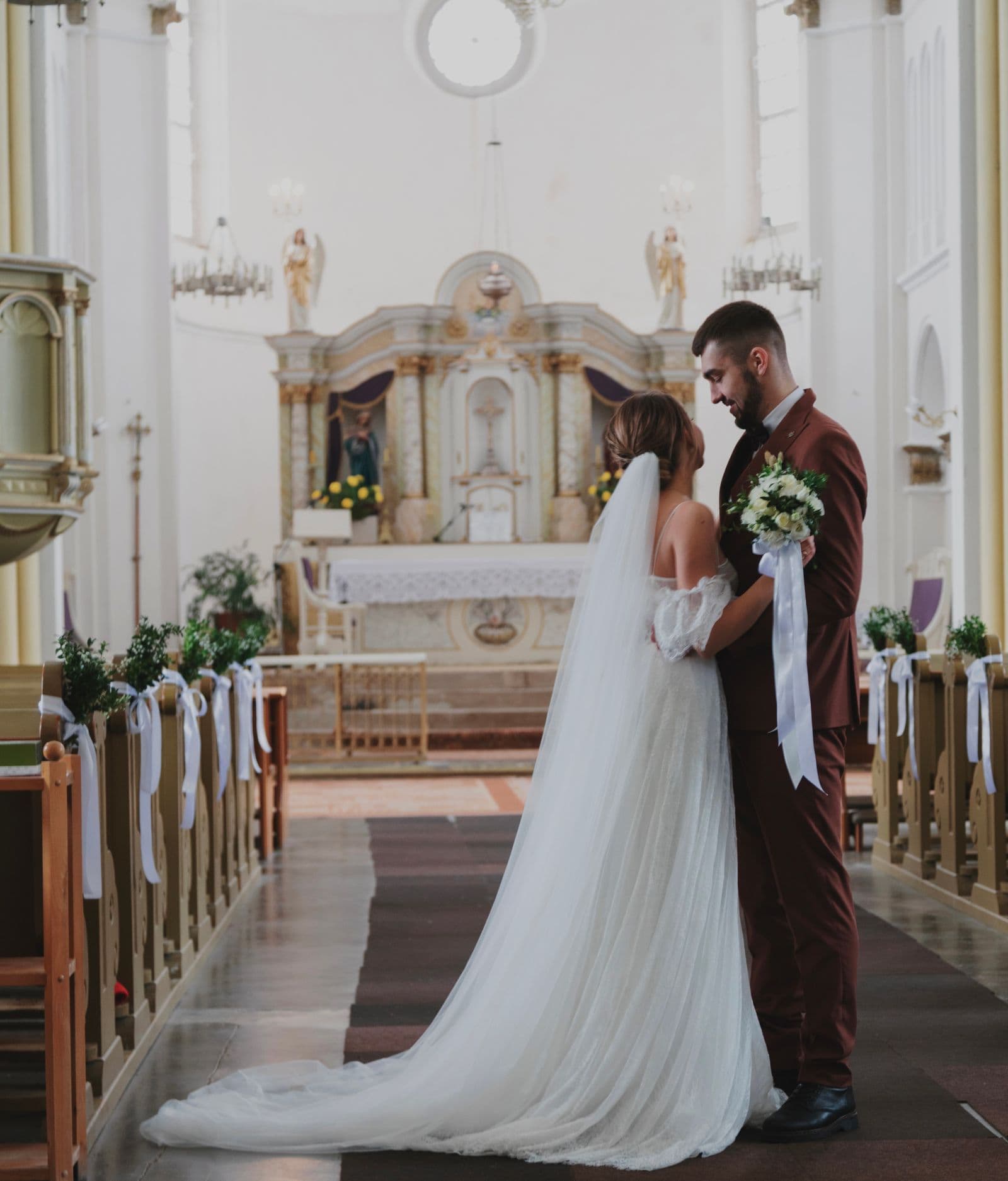
For Christian couples, invitations carry a little extra weight. They are the first signal to your guests about what kind of ceremony they are walking into: a faith-centered, God-honoring celebration, not just a nice party. Getting the wording right does not mean loading the card with scripture, though a verse or two goes a long way. It means choosing language that is consistent with the spirit of the day.
This guide breaks down every component of a Christian wedding invitation, offers sample wording for formal, semi-formal, and casual styles, and walks through the faith touches that feel natural versus the ones that feel forced.
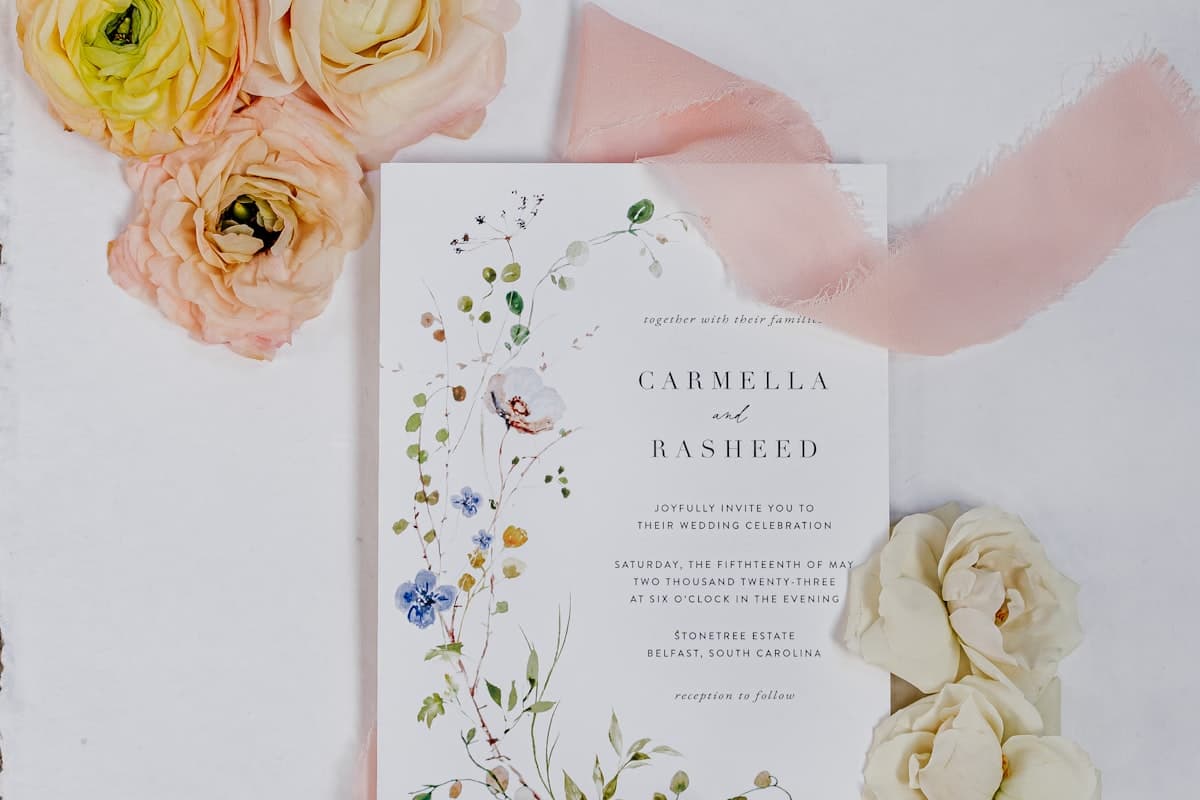
The parts of a Christian wedding invitation
Most Christian wedding invitations follow the same basic structure, with room to adjust tone and include faith elements at each step.
- The host line (who is issuing the invitation: the couple, the parents, or both)
- The invitation phrase ("request the honor of your presence" or "joyfully invite you to celebrate")
- The couple's names
- The date and time (written out in full for formal invitations)
- The ceremony location
- A scripture verse or faith statement (optional but genuinely meaningful)
- Reception details
The faith elements can show up in the invitation phrase, in a scripture verse at the bottom, in a line asking guests to pray, or simply in the word choices throughout. You do not need all of them. Even one done well says what you want it to say.
Sample wording: formal Christian wedding invitation
This style works well for a church ceremony with a plated dinner reception. Dates and times are written out in full, and the language is traditional without feeling stiff.
Mr. and Mrs. David Mitchell and Mr. and Mrs. Robert Collins
request the honor of your presence
at the marriage of their children
Sarah Ann Mitchell
and
James Robert Collins
Saturday, the twenty-first of March, two thousand twenty-six
at half past three o'clock in the afternoon
Christ the King Church
Raleigh, North Carolina
Reception to follow immediately
"What God has joined together, let no one separate." (Mark 10:9)
Sample wording: semi-formal
A warm middle ground that honors both families without the stiffness of fully formal language. Common for couples who want something elegant but approachable.
Together with their families
Emma Walsh and Daniel Torres
invite you to celebrate their wedding
Saturday, March 21, 2026, at 3:30 in the afternoon
Christ the King Church
Raleigh, North Carolina
Dinner and dancing to follow
"Two are better than one, because they have a good return for their labor." (Ecclesiastes 4:9)
Sample wording: casual and modern
If your ceremony is relaxed, outdoors, or smaller in scale, a casual invitation often feels more genuine than a formal one. This style works even for church weddings where you want the invitation to sound like you, not like a document.
We're getting married, and we want you there.
Emma Walsh and Daniel Torres
are saying their vows on March 21, 2026, at 3:30 pm
Christ the King Church, Raleigh, NC
Dinner, music, and way too much joy to follow.
We'd love to celebrate with you.
We ask for your prayers as we prepare for this day.
How to include a scripture verse without it feeling like a sermon
Keep it short, let it breathe, and do not over-explain it. A two-line scripture quote at the bottom of a formal invitation reads as intentional and elegant. The same verse with a paragraph of explanation reads like a Sunday school handout.
The verse should stand on its own as a blessing, not a doctrinal statement. These tend to work well on a Christian wedding invitation:
- "Where you go I will go, and where you stay I will stay." (Ruth 1:16), a lovely choice for couples from different backgrounds building one life together
- "Two are better than one." (Ecclesiastes 4:9)
- "Beloved, let us love one another, for love is from God." (1 John 4:7)
- "Give thanks to the Lord, for he is good." (Psalm 136:1), setting a tone of gratitude for the whole day
- "What God has joined together, let no one separate." (Mark 10:9)
- "I have found the one whom my soul loves." (Song of Solomon 3:4)
Avoid verses that read more naturally as corporate worship or that sound like instructions to the congregation. Stick to verses that feel like a blessing or a declaration of love. For a fuller set of passages that work beautifully in ceremony contexts, our guide to Bible verses for weddings has them grouped by theme so you can find the ones that fit your relationship best.
Asking guests to pray for you
This is one of the most meaningful things a Christian wedding invitation can include, and almost no one does it. A simple line like "We ask for your prayers as we begin this new chapter" changes the entire tone of the invitation. It is not just an announcement that a party is happening; it is an invitation into something sacred. It tells your guests that your faith is not a backdrop to the celebration but the center of it.
If you want to be more specific, you can include a brief prayer prompt:
"We invite you to pray for us in the weeks ahead, for wisdom, joy, and a marriage that honors God."
Keep it to one or two sentences. The goal is warmth, not a prayer bulletin. And if you want to see how prayer weaves through the ceremony itself, our post on Christian wedding prayers covers sample wording for every moment, from the opening blessing to the benediction.
Who is doing the inviting? Host line options
The host line is more flexible now than it used to be. The traditional form ("Mr. and Mrs. David Mitchell request the honor of your presence at the marriage of their daughter...") implied the bride's parents were hosting, which made sense when they typically planned and paid for the wedding.
Today couples split costs with families in all kinds of ways. Here are honest options for the host line:
- Parents hosting (traditional): "Mr. and Mrs. David Mitchell and Mr. and Mrs. Robert Collins request the honor of your presence at the marriage of their children..."
- Couple and families together: "Together with their families, Emma and Daniel invite you to celebrate their wedding..."
- Couple hosting: Just the couple's names at the top with no host line at all. This is honest, clean, and increasingly common.
- Collective framing: "The families of Emma and Daniel joyfully invite you...", a warmer option when blended families are involved or when you want to honor everyone without listing names individually.
None of these is more or less Christian than another. Choose the one that accurately reflects who is hosting and how you want to honor the people who helped make this day possible.
Naming the church versus just giving the address
For most Christian couples, naming the church adds something. "Christ the King Church, 1234 Oak Street, Raleigh, North Carolina" tells your guests what they are walking into, not just where to park. For guests who are members of the congregation, the church name is often how they naturally identify the location anyway.
If your ceremony is at a venue rather than a church, the faith language elsewhere in the invitation carries the meaning. A phrase like "in a ceremony of worship" or "before God and family" does the same work. You do not need to add a church name that is not accurate.
Digital invitations and your wedding website
More couples are using digital invitations now, for environmental reasons, budget, or convenience. All the wording above transfers directly to a digital format. One thing a digital invitation adds is a natural place to link to your wedding website:
"Please RSVP and find all the details at altarwed.com/wedding/emma-and-daniel"
Your website is where guests can RSVP, find hotel recommendations, get directions, and feel connected to your story in the weeks before the ceremony. It frees your invitation to stay elegant and short, which is how it should be. For more on what to include on your site and how to write those pages in a voice that feels like you, see our guide to building a Christian wedding website.
And once the words on the invitation are right, the words inside the ceremony are the next thing to get right. Our guide to Christian wedding program wording has sample text for every section of the bulletin your guests will hold in their hands during the service.
Frequently asked questions about Christian wedding invitation wording
Do we have to include a scripture verse on the invitation?
No. A Christian wedding invitation can feel distinctly faith-centered through tone alone. Phrases like "in a ceremony of worship," "before God and family," or "we ask for your prayers" signal what kind of day it is without a verse. Include one if it feels genuine; skip it if it would feel like checking a box.
How formal should our wording be?
Match the formality of the invitation to the formality of the day. A candlelit church service with a formal dinner calls for written-out dates and traditional language. A garden ceremony with a casual outdoor reception reads more authentically with modern, relaxed wording. The invitation sets the expectation for the day, so let it tell the truth about what guests are walking into.
How long should the wording be?
Short. A guest should be able to read the invitation in thirty seconds and know who, what, when, and where. Everything else belongs on your wedding website or inside the ceremony program. If you find yourself writing a paragraph of explanation on the card itself, move it to the website instead.
Can we mention gifts on the invitation?
Etiquette traditionally suggests mentioning gifts only on a separate enclosure card or your wedding website, not on the invitation itself. "In lieu of gifts, we welcome contributions to..." reads well as a line on an RSVP card or a website page. The invitation focuses on the celebration, not the logistics.
The invitation is just the beginning
Once the invitations go out and RSVPs start arriving, your wedding website becomes the hub where guests confirm attendance, find directions, and stay connected to your story in the weeks before the ceremony. Create your free AltarWed wedding website so you have one clear link to put on every invitation, digital or printed, and a single place where all your guests can find everything they need.